
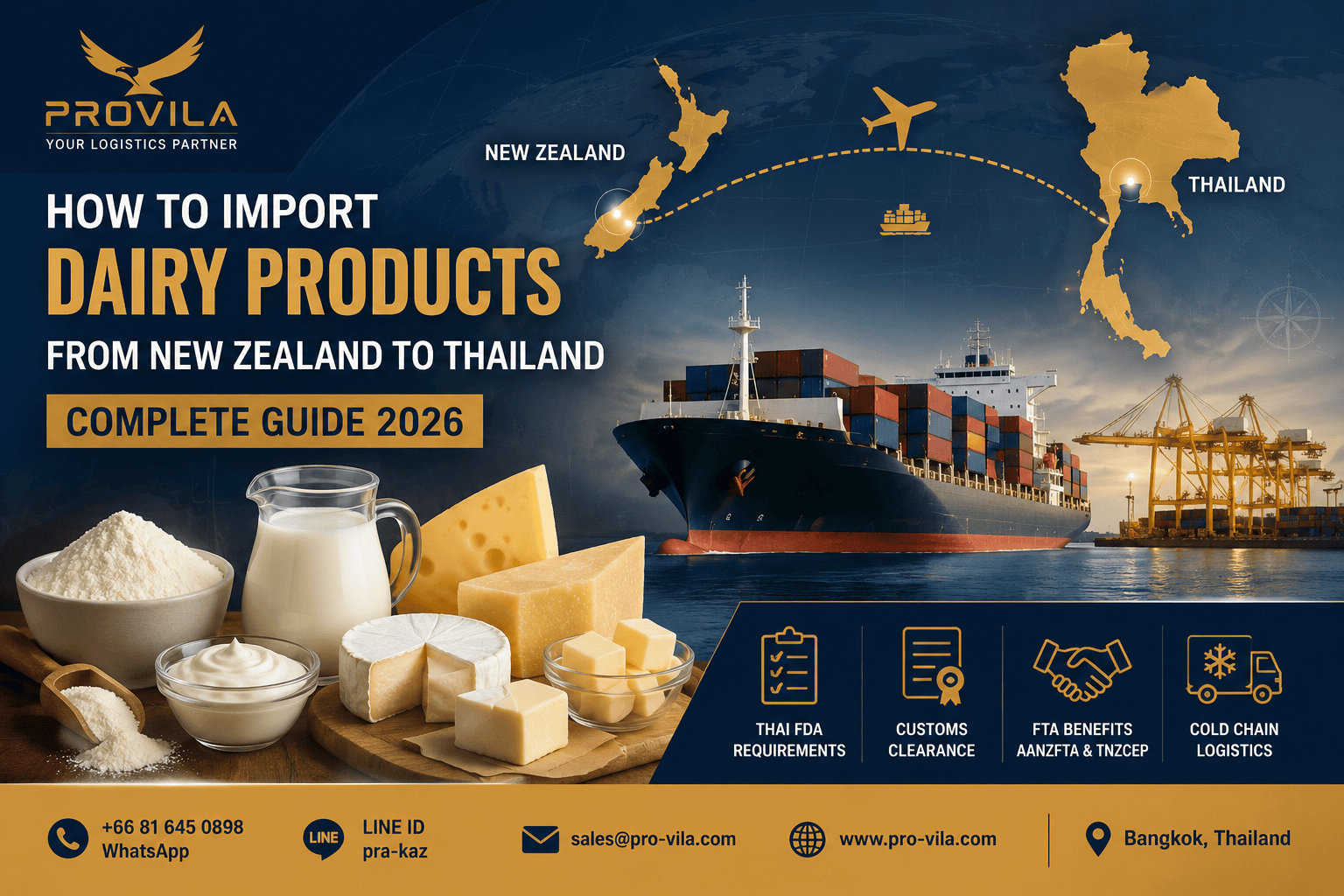
Importing dairy products from New Zealand into Thailand involves more than arranging freight and filing a customs declaration. Depending on the product, an importer may need a Thai FDA food import licence, product-related permissions or records, appropriate manufacturing-standard documentation, import inspection procedures, customs documentation, and potentially additional trade-control requirements.
The exact requirements can differ significantly between milk powder, cheese, butter, cream, whey products, nutritional products, and other dairy-based foods.
For this reason, the first step should normally be to classify the product and confirm its regulatory requirements before the shipment leaves New Zealand.
This guide provides an overview of the process and the key areas importers should check.
1. Start With Product Classification
Before booking the shipment, identify exactly what is being imported.
Important information normally includes:
- Product name and description
- Ingredients and composition
- Intended use
- Packaging and pack size
- Manufacturer
- Country of origin
- HS Code or proposed tariff classification
- Product specification
- Label
- Storage and temperature requirements
This matters because Thai regulatory requirements are not identical for every dairy product.
Thai FDA distinguishes between foods that require a food serial number and general foods that may instead be recorded through its Virtual Number System. Therefore, it is not accurate to assume that every dairy product follows exactly the same product-registration process.
Provila Tip: Complete the regulatory review before confirming the first commercial shipment.
2. Obtain the Thai FDA Food Import Licence
A business importing food into Thailand for commercial sale generally needs a License for Importation or Ordering of Food into the Kingdom — Form Orr. 7 (อ.7).
Thai FDA's official procedure requires the applicant to apply for the food-import premises licence through its e-Submission system and complete the relevant approval process.
This distinction is important because the Draft originally described the core dairy import licence as a DFT licence.
For food importation, the Thai FDA import licence (อ.7) is a key requirement.
DFT requirements may also become relevant for particular products or trade-control measures, but these should be checked separately according to the product and HS classification.
3. Determine Whether the Product Needs a Food Serial Number
Having an FDA food import licence does not automatically complete the regulatory process for every product.
Thai FDA explains that foods falling into categories requiring a food serial number must go through the applicable product-permission procedure.
After approval, the importer receives the relevant food serial number.
For certain general foods that do not require an FDA number, Thai FDA provides a different procedure using its Virtual Number System.
Therefore, instead of asking: “Does dairy need FDA registration?”
a more useful question is: “How is this specific dairy product classified by Thai FDA, and what permissions or records apply to it?”
That determination should be made before shipment.
4. Check Accreditation Certificate (GMP/ISO/BRC,..etc)
Importers should also check whether the product requires evidence concerning the overseas manufacturer's food-quality or manufacturing system.
New Zealand's Ministry for Primary Industries specifically notes that Thailand has GMP-related requirements covering a list of food products and that qualifying products require an appropriate food quality assurance system certificate at relevant stages, including product registration and border clearance.
This is another reason why the supplier and manufacturer should be involved early in the import planning process.
Depending on the product, documents may include manufacturing or quality-system evidence and other supporting product documentation.
Do not wait until the container is already sailing to request these documents.
5. Check Thai Labelling Requirements Before Shipping
Food labelling is another area that should be reviewed before commercial importation.
The applicable requirements depend on the product classification and Thai food regulations.
Instead of simply translating the New Zealand label into Thai, the importer should determine which mandatory information and formatting requirements apply to the particular product.
For products requiring Thai FDA product permission, the label and product information should also remain consistent with the approved details.
For first-time imports, label review should therefore be part of the pre-shipment compliance process rather than something handled only after the cargo reaches Thailand.
6. Confirm Requirements on the New Zealand Side
Compliance is required at both ends of the shipment.
New Zealand MPI states that dairy exporters must comply with New Zealand legislation and relevant food standards, while also meeting the overseas market access requirements of the destination country.
For dairy exports outside Australia, production and processing generally need to operate under an appropriate registered Risk Management Programme (RMP), and the exporter must meet the applicable export requirements.
Commercial animal-product exporters also generally need to be registered with MPI or use the services of an appropriately registered exporter.
7. Check Whether an Export Certificate Is Required
New Zealand exporters must also check the applicable Overseas Market Access Requirements (OMAR) for Thailand.
MPI explains that where the destination market requires an official assurance, the exporter must obtain the relevant export certificate before sending the product.
For dairy, certification has traditionally been handled through MPI's E-cert system.
There is an important 2026 development here.
MPI is transitioning export certification to its newer MPI Trade Certification system. The transition began in March 2026 for certain certificate types, while AP E-cert users are scheduled to migrate by the end of 2026.
Exporters should therefore confirm the applicable certification system and requirements at the time of shipment.
8. Arrange Freight From New Zealand to Thailand
Once the regulatory and documentation requirements have been checked, freight planning can begin.
Common New Zealand export gateways include:
For Thailand, sea freight may move through ports such as Laem Chabang, depending on the routing and carrier.
Depending on cargo volume and product characteristics, options can include:
FCL — Full Container Load Suitable when cargo volume justifies use of a full container.
LCL — Less than Container Load Potentially suitable for smaller shipments, subject to product characteristics, consolidation requirements and total logistics cost.
Reefer Container Used where the product requires controlled temperature throughout transportation.
Air Freight May be considered for urgent, smaller or higher-value shipments.
The correct solution should be selected based on the actual product's temperature requirements, shelf life, packaging, shipment size and commercial priorities rather than simply choosing the lowest freight rate.
9. Prepare the Import Documentation
The exact document set varies according to the shipment and product.
Typical documents may include:
- Commercial Invoice
- Packing List
- Bill of Lading or Air Waybill
- Relevant Thai FDA license / permission information
- Product information
- Certificate of Origin where preferential tariff treatment is claimed
- Manufacturing/GMP-related documentation where applicable
- New Zealand export or health certification where required
- Other product-specific permits or certificates
Thai FDA also uses import inspection procedures connected with Thailand's National Single Window.
For food requiring a food serial number, its official procedure includes registration for the License per Invoice (LPI) process through NSW.
The final document checklist should therefore be prepared for the specific product and shipment, rather than relying on one universal dairy-import checklist.
10. Check Customs Duty and Preferential Tariff Options
New Zealand-origin goods may potentially qualify for preferential tariff treatment under an applicable trade agreement, provided all relevant requirements are satisfied.
However:
New Zealand origin does not automatically mean zero import duty.
Eligibility depends on factors including the HS Code, applicable tariff schedule, rules of origin, origin documentation and any product-specific requirements.
Dairy products require particular care because individual tariff lines can be subject to different conditions.
Before shipment, the importer should therefore confirm:
HS Code → applicable tariff → FTA eligibility → rules of origin → required origin documentation → any applicable quota or product-specific requirements.
This is considerably safer than assuming every New Zealand dairy shipment will receive a zero-duty AANZFTA rate.
11. Customs and FDA Clearance in Thailand
Once the shipment arrives in Thailand, the importer and customs broker must complete the applicable import procedures.
Depending on the shipment, this can involve both Thai Customs and Thai FDA import-inspection requirements.
The clearance process may include verification of:
- Customs declaration
- Commercial documents
- Product classification
- FDA information
- Import permissions
- Origin documentation
- Product/manufacturing certificates
- Other supporting documents
Additional inspection, sampling or regulatory procedures may apply depending on the product and risk profile.
Because these requirements are product-specific, documents should ideally be reviewed before departure from New Zealand.
12. Inland Transportation and Cold Chain
After clearance, the cargo must be transported from the port, airport or cargo facility to the importer's warehouse or final destination.
For temperature-sensitive dairy products, maintaining the required temperature throughout the logistics chain is particularly important.
This may involve:
Reefer container → port clearance → refrigerated trucking → cold-storage warehouse
Temperature requirements should follow the product specification and manufacturer's storage instructions.
Common Mistakes When Importing New Zealand Dairy Into Thailand
Several problems can be prevented through proper pre-shipment planning.
1. Shipping before regulatory requirements are confirmed
A supplier may be ready to export while the Thai importer is not yet ready to legally import that particular product.
2. Assuming every dairy product has the same FDA process
Product classification matters. Different foods can follow different FDA permission or recording procedures.
3. Requesting manufacturer documents too late
GMP or other manufacturing evidence can become important during product permission and import procedures.
4. Assuming New Zealand origin automatically means zero duty
FTA benefits depend on the specific tariff classification and applicable origin requirements.
5. Checking the label only after the cargo has departed
Label compliance should be reviewed during product preparation.
6. Comparing freight rates without comparing total logistics cost
Freight, local charges, free time, customs requirements, temperature control, transit time and inland delivery can all affect the total cost of the shipment.
How Provila Can Support New Zealand → Thailand Shipments
Provila Logistics supports businesses planning international shipments into Thailand.
Depending on the shipment and agreed scope of service, our team can coordinate areas including:
Before You Ship: The Provila Dairy Import Checklist
Before asking your New Zealand supplier to ship, confirm these areas:
- Product classification / HS Code
- Thai FDA importer licence status
- FDA product requirements
- GMP/manufacturing documentation
- Thai labelling requirements
- New Zealand export certification requirements
- Customs duty and potential FTA treatment
- Certificate of Origin requirements
- Shipping documents
- Temperature and cold-chain requirements
The best time to identify an import problem is before the cargo leaves New Zealand — not after it arrives in Thailand.
Planning to Import Dairy Products From New Zealand?
Before booking your shipment, send Provila the following information:
Our team can use this information as the starting point for reviewing the logistics and import requirements applicable to your shipment.
PROVILA LOGISTICS
International Freight • Customs Clearance • Import–Export Coordination
Your Trusted Logistics Partner.