
Author: Provila Holding Co., Ltd.
Category: Import & Export | Customs Clearance | Thai DFT Quota
Target audience: Dairy importers, food manufacturers, purchasing managers, and international trading companies
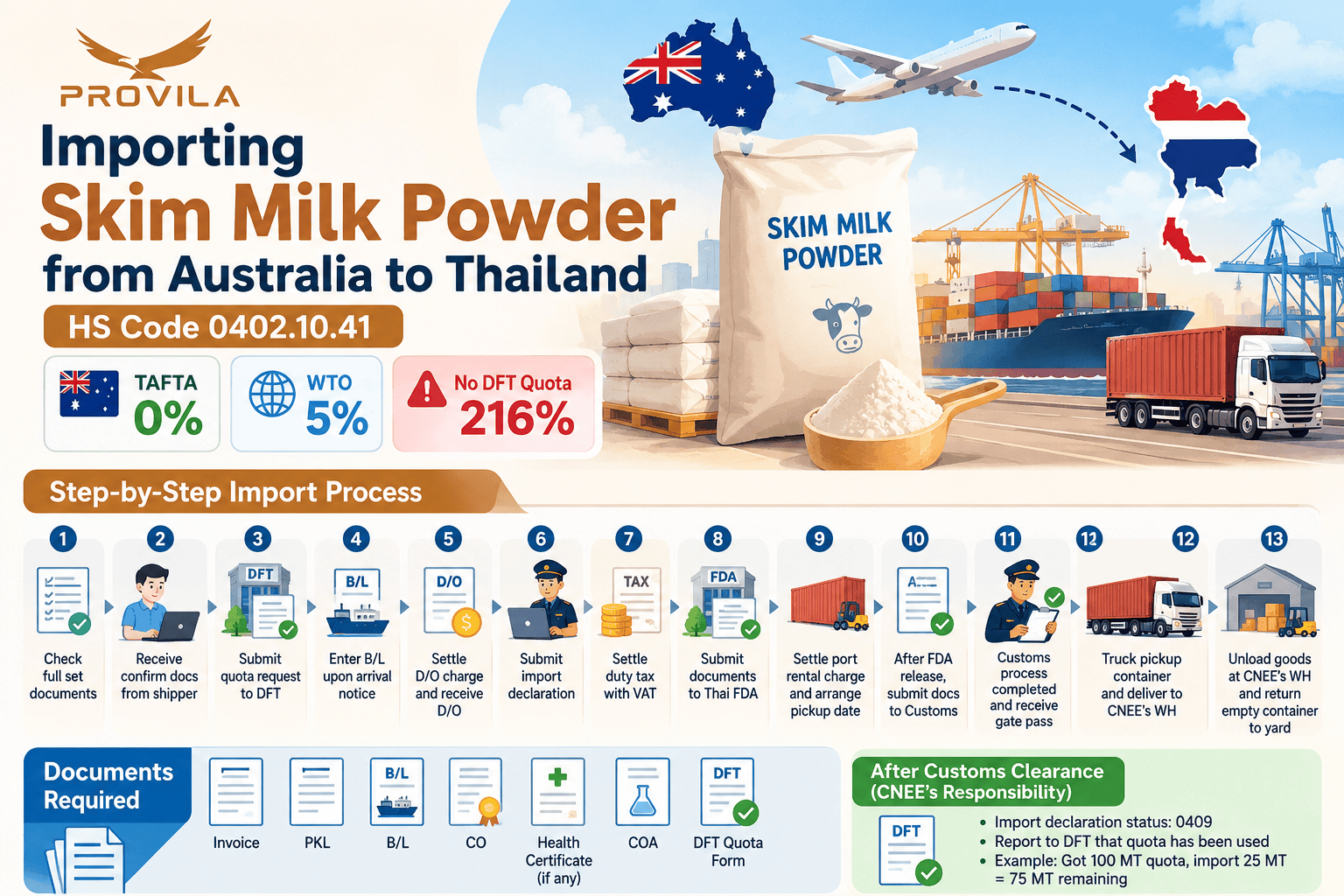
1. Overview: Importing Skim Milk Powder into Thailand
Importing skim milk powder from Australia to Thailand requires more than arranging freight and preparing customs documents. Importers must understand the applicable customs tariff, preferential trade agreement requirements, Department of Foreign Trade (DFT) quota procedures, and food-import clearance requirements.
For skim milk powder classified under HS Code 0402.10.41, the applicable duty treatment depends on the product classification, country of origin, eligibility for preferential treatment, and the relevant import quota and supporting certificates.
Under the Thailand–Australia Free Trade Agreement (TAFTA), qualifying Australian-origin products may be eligible for preferential tariff treatment. However, importers must verify the applicable requirements and obtain the necessary documentation before shipment. The DFT identifies skim milk powder under this tariff heading as a product subject to import measures. Official DFT information
2. HS Code and Import Duty: TAFTA vs. WTO
The following rates are indicative figures for shipment planning and should be confirmed against the current Thai Customs tariff and the applicable DFT quota or preferential-duty certificate before importation.
| Import treatment | Indicative import duty |
|---|---|
| TAFTA preferential treatment | 0% |
| WTO rate within the applicable quota | 5% |
| Applicable out-of-quota treatment | May be substantially higher; confirm the current rate |
Important: A 0% TAFTA rate should not be assumed solely because the goods are shipped from Australia. The goods must qualify under the applicable origin rules, and the importer must meet the relevant documentation and tariff-quota requirements. The Australian Government's TAFTA information specifically notes that skim milk powder has been subject to tariff-rate quota arrangements. TAFTA official information
If the importer does not have the required quota allocation or cannot satisfy the applicable conditions, the shipment may not qualify for the expected preferential or in-quota rate. An out-of-quota duty rate as high as 216% has been cited for this product scenario, but the exact applicable rate and legal basis must be verified for the shipment before the goods are dispatched.
Our recommendation is simple: confirm the tariff treatment and quota status before shipping the cargo to Thailand. This helps reduce the risk of unexpected import costs, clearance delays, and storage or container-related expenses.
3. Required Documents for Customs Clearance
Before the shipment arrives in Thailand, the importer and shipper should prepare the complete document set.
The typical documents include:
Commercial Invoice – showing the seller, buyer, product description, quantity, unit price, and total value.
Packing List (PKL) – showing package details, weights, and quantities.
Bill of Lading (B/L) – the transport document issued for the shipment.
Certificate of Origin (CO) – supporting the claimed country of origin and any applicable preferential treatment.
Health Certificate, if applicable – depending on the product and requirements of the relevant authority.
Certificate of Analysis (COA) – providing the product's analytical specifications.
DFT quota or preferential-duty certificate/documentation – as required for the selected import scheme.
Additional documents or approvals may be required depending on the product, importer, intended use, and applicable Thai FDA and DFT regulations.
Document tip: Ask the shipper to send draft documents for checking before the original documents are issued or the cargo is dispatched. Product descriptions, weights, origin information, and consignee details should be consistent across the document set.
4. Step-by-Step Import and Customs Clearance Process in Thailand
A coordinated clearance process helps the importer manage documentation, duty payment, port charges, regulatory release, and final delivery.
Step 1: Check the complete document set
Review the invoice, packing list, B/L, CO, COA, health certificate if applicable, and relevant quota documentation.
Step 2: Obtain confirmation from the shipper
Confirm that the complete set of documents has been issued and that the information is consistent and ready for clearance.
Step 3: Submit the quota documentation to DFT
Submit the required application or supporting documents to the Department of Foreign Trade under the applicable quota or preferential-duty procedure. The correct procedure depends on the import scheme being used.
Step 4: Receive the arrival notice and enter the B/L
Once the shipping line issues the arrival notice, arrange the required B/L processing and coordinate the next steps with the carrier.
Step 5: Settle the Delivery Order (D/O) charges
Pay the shipping line's applicable charges and obtain the Delivery Order.
Step 6: Submit the import declaration
Prepare and submit the customs import declaration with the correct tariff classification, customs value, origin details, and supporting documents.
Step 7: Pay import duty and VAT
Pay the applicable import duty and VAT based on the confirmed tariff treatment and customs assessment.
Step 8: Submit the documents to the Thai FDA
Provide the required product and shipment documents to the Thai Food and Drug Administration for the applicable review and release process. The exact requirements depend on the product and import authorization.
Step 9: Settle port rental or storage charges and arrange pickup
Check the applicable port charges, settle outstanding amounts, and coordinate the container pickup date with the transport provider.
Step 10: Complete the required FDA and Customs release procedures
Once the relevant FDA release has been obtained, submit the required documents to Customs and complete any outstanding inspection, verification, or release procedures.
Step 11: Obtain the gate pass and transport the container
After Customs has completed the release process, hand the gate-pass documents to the truck operator and arrange collection from the port.
Step 12: Deliver and unload at the consignee's warehouse
Transport the container to the consignee's warehouse (CNEE's WH), unload the cargo, and confirm delivery.
Step 13: Return the empty container
Return the empty container to the designated container yard according to the shipping line's booking instructions and applicable deadlines.
Operational note: The exact order of certain steps may vary depending on the port, shipping line, cargo status, inspection requirements, and the relevant authority's procedures.
5. The Consignee's Responsibility After Customs Clearance: DFT Quota Reporting
Importers should not overlook their responsibilities after the goods have been cleared.
For applicable quota-controlled imports, the consignee must complete the required DFT reporting or quota-utilization process using the relevant customs declaration and supporting records. The applicable declaration status, including status code 0409 where relevant to the procedure, should be verified with the responsible authority or customs broker.
Example: How quota utilization works
Suppose a consignee receives a DFT quota allocation of 100 metric tonnes (MT) and imports 25 MT of skim milk powder under that quota.
| Item | Quantity |
|---|---|
| Original quota allocation | 100 MT |
| Quantity used for this shipment | 25 MT |
| Remaining quota, assuming no other usage or adjustment | 75 MT |
The consignee should ensure that the shipment is properly recorded against the relevant quota and that the required post-import reporting is completed.
Keeping accurate quota records helps the importer monitor the remaining allocation and plan future shipments.
6. Common Risks When Importing Skim Milk Powder
Importers should pay particular attention to the following risks:
Shipping before confirming quota availability: The expected duty treatment may not be available for the shipment.
Incorrect tariff classification: Product specifications, fat content, packaging, and other classification details must be checked.
Incomplete origin documents: Preferential treatment may be rejected if the required origin evidence is missing or invalid.
Inconsistent shipping documents: Differences in product descriptions, quantities, or consignee details can delay processing.
Missing product approvals: Thai FDA or other regulatory requirements may affect release.
Unexpected port and container charges: Delays may increase storage, rental, or related expenses.
Incomplete post-import quota reporting: The importer may need to take additional action to ensure the quota usage is correctly recorded.
Planning these steps before shipment can help businesses reduce avoidable costs and improve the predictability of their import operations.
7. How Provila Supports DFT Quota-Controlled Imports
Provila Holding Co., Ltd. supports importers with freight forwarding, customs clearance, import documentation, and coordination with the relevant parties involved in Thai import procedures.
For skim milk powder and other quota-controlled products, our support can include:
Reviewing the preliminary shipment documents.
Coordinating with the shipper, consignee, and freight partners.
Supporting the preparation and submission of required import documentation.
Coordinating DFT quota-related procedures with the importer.
Arranging customs clearance and applicable FDA documentation processes.
Coordinating port collection, container trucking, warehouse delivery, and empty-container return.
Helping the consignee track post-import documentation and quota-utilization requirements.
Our approach emphasizes clear communication, coordinated execution, and transparent quotations so that customers can better understand the process and expected costs before proceeding.
8. Planning to Import Skim Milk Powder into Thailand?
Before booking your shipment from Australia, confirm your HS code, applicable duty rate, quota eligibility, origin documentation, and Thai FDA requirements.
Contact Provila Holding Co., Ltd. for assistance with skim milk powder imports, DFT quota-controlled products, customs clearance, and end-to-end logistics coordination in Thailand.
Website: https://www.pro-vila.com/
Provila — Your partner for transparent and coordinated international logistics.
Frequently Asked Questions
1. What is the HS code for skim milk powder?
HS Code 0402.10.41 covers certain milk or cream in powder, granules, or other solid forms with a fat content not exceeding 1.5% by weight, without added sugar or other sweetening matter, in containers with a gross weight of 20 kg or more. Confirm the full Thai tariff classification against the actual product specifications.
2. Can Australian skim milk powder enter Thailand at 0% duty under TAFTA?
It may qualify for preferential treatment if the product meets the relevant origin rules and the importer satisfies the applicable quota and documentation requirements. Confirm the current conditions before shipping.
3. What happens if the importer does not have quota?
The shipment may not qualify for the expected in-quota or preferential duty treatment. The applicable out-of-quota rate and import conditions must be checked before dispatch.
4. Is a Certificate of Origin required?
Origin documentation is important when claiming preferential treatment. The specific certificate or supporting document required depends on the applicable scheme and current rules.
5. Does the importer have responsibilities after Customs releases the goods?
Yes. The importer should complete any applicable DFT quota-utilization reporting, retain supporting documents, and verify that the shipment is recorded correctly against the quota allocation.
Regulatory disclaimer: This article provides general logistics and import-planning information, not a binding tariff determination or legal opinion. Duty rates, quota allocations, documentary requirements, and agency procedures may change. Confirm the current requirements with Thai Customs, the Department of Foreign Trade, and the Thai FDA before shipping.