
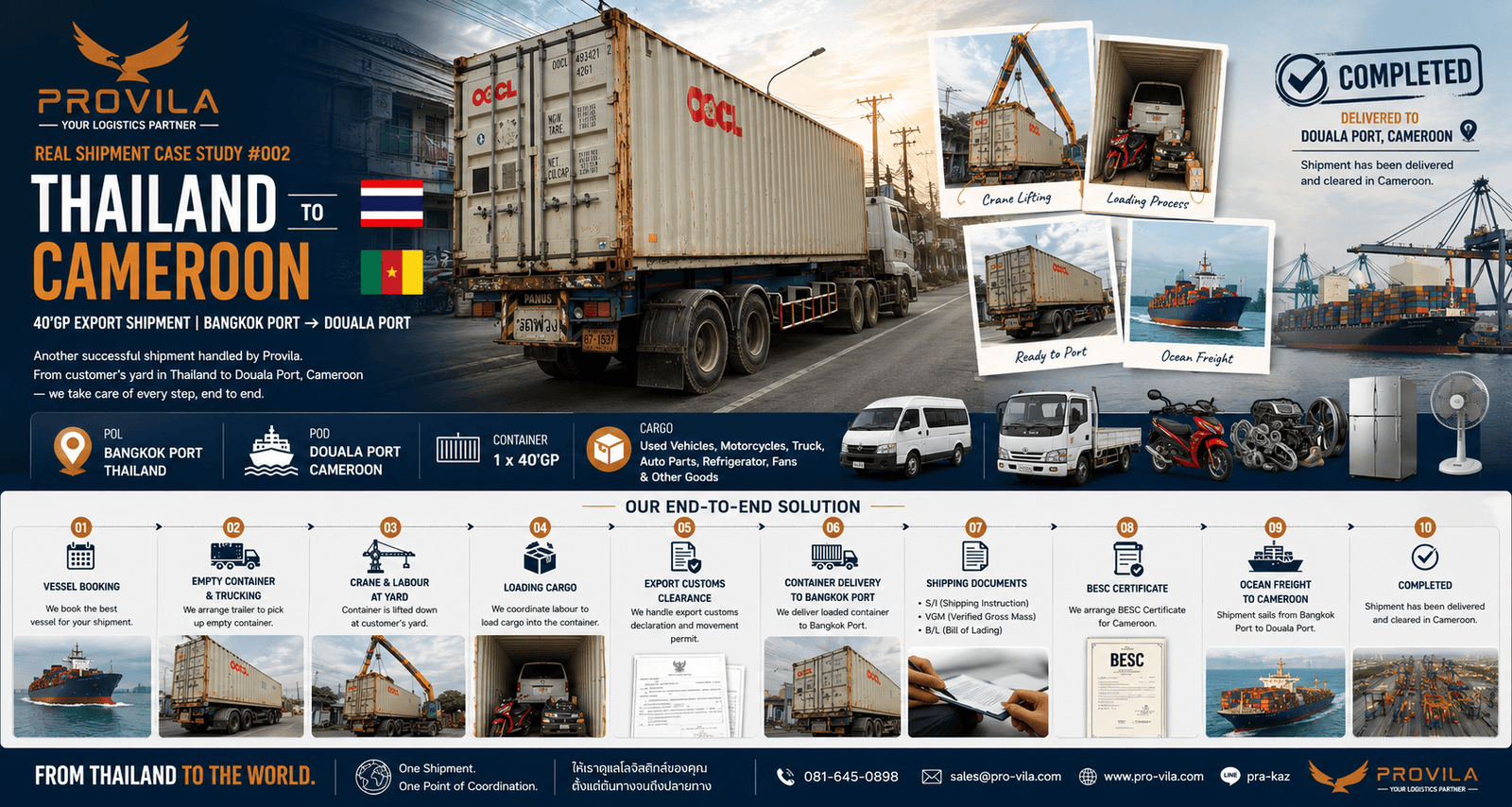
Real Shipment Case Study #002: Thailand → Cameroon
Exporting used vehicles and mixed cargo from Thailand to Cameroon is not simply a matter of booking a vessel and sending a container to port.
A successful export requires several activities to work together in the correct sequence: document preparation, vehicle-related requirements, container planning, trucking, crane operations, labour, loading, export customs clearance, shipping documentation, and destination-related certificates.
This case study covers a real shipment handled by Provila Holding Co., Ltd. from Bangkok Port, Thailand to Douala Port, Cameroon.
The shipment was completed using 1 × 40'GP container, and the cargo successfully arrived in Cameroon and was cleared at destination.
Client, vehicle registration, commercial values and other confidential shipment information have been omitted.
Shipment at a Glance
| Item | Shipment Details |
|---|---|
| Origin | Thailand |
| Port of Loading (POL) | Bangkok Port |
| Destination Country | Cameroon |
| Port of Discharge (POD) | Douala Port |
| Container | 1 × 40'GP |
| Cargo Type | Used vehicles, motorcycle, auto parts and other goods |
| Shipment Status | Completed and cleared in Cameroon |
Cargo loaded in the container included:
- Used van
- Six-wheel truck
- Motorcycle
- Automotive spare parts
- Refrigerator
- Fans
Because several different cargo types were loaded into the same container, careful planning of the loading process and shipment documentation was especially important.
Why This Shipment Required More Than Ocean Freight
From the customer's perspective, this was one export shipment.
Operationally, however, it involved multiple service providers and activities:
- Shipping line
- Container depot
- Tractor / trailer
- Crane
- Labour
- Export customs procedures
- Port operations
- Shipping documentation
- Cameroon BESC certification
Instead of coordinating these parties separately, the customer appointed Provila as the central logistics coordinator.
The objective was simple: One Shipment. One Point of Coordination.
Step 1: Customer Prepares the Export Documents
Before the physical movement of the container began, the customer prepared the key documents required for the shipment.
These included:
Department of Land Transport documentation
Because the shipment included used vehicles, the customer prepared the relevant documentation from Thailand's Department of Land Transport (DLT) for the export process.
Vehicle exports require additional preparation compared with general cargo, so the vehicle-related documentation should be reviewed before loading and export customs procedures begin.
Commercial Invoice
The Commercial Invoice describes the goods being exported and provides the commercial information used in the shipment documentation and customs process.
Packing List
The Packing List identifies the cargo included in the shipment.
For this case, that was particularly important because the container contained several different types of goods.
Provila used the customer-provided information as part of the preparation for the export process.
Step 2: Vessel Booking from Bangkok to Douala
Once the shipment information was available, Provila arranged the ocean freight booking.
The route was: Bangkok Port, Thailand → Douala Port, Cameroon
Container type: 1 × 40'GP
The booking process was not considered separately from the loading plan.
The vessel schedule, container pickup, loading date, export customs procedures and port cut-off had to be coordinated so that the container could reach Bangkok Port within the required shipping timeline.
This is one of the key differences between simply purchasing freight and managing a complete export shipment.
A freight rate is only one part of the operation.
The other activities need to fit around the vessel schedule.
Step 3: Empty Container and Trucking Arrangement
After the booking was confirmed, Provila arranged a tractor unit to pick up the empty 40'GP container and transport it to the customer's yard.
For many export shipments, the container remains mounted on the trailer during loading.
For this shipment, however, the customer's loading arrangement required the container to be placed down at the yard.
That meant additional equipment and coordination were necessary.
Step 4: Crane and Labour Coordination at the Customer's Yard
Provila coordinated:
- Tractor / trailer
- Crane
- Labour team
- Container positioning
- Loading operation
The crane was used to lift the empty container down from the trailer at the customer's yard.
Once the container was positioned correctly, the loading team could begin arranging the vehicles and other cargo inside.
This step demonstrates why complex export shipments require detailed coordination.
If the crane arrives but the container is not ready, or the labour team arrives before the equipment, time and cost can quickly increase.
Each party therefore needed to follow the same loading schedule.
Step 5: Loading the Cargo into the 40'GP Container
The cargo consisted of several different items: Used Van, Six-wheel Truck, Motorcycle, Automotive Spare Parts, Refrigerator, Fans
All were loaded within the same 40'GP container.
Mixed cargo requires careful planning because different goods have different dimensions, weights and handling requirements.
The loading team needed to make efficient use of the available container space while maintaining a practical arrangement for transportation.
Provila coordinated the labour and equipment required for the loading process.
Once loading was completed, the container was prepared for onward transport to Bangkok Port.
Step 6: Export Customs Clearance
Provila handled the export customs procedures for the shipment.
The scope included preparation and submission of the:
Export Customs Declaration
The export declaration was prepared using the shipment and cargo information provided in the supporting documentation.
Cargo Movement / Transport Control Document
Provila also prepared the relevant movement documentation required for transportation of the export cargo through the customs process.
Export customs procedures are an important milestone because the physical movement of the container, document preparation and port schedule must all remain aligned.
A delay in one area can affect the entire shipping plan.
Step 7: Loaded Container Delivered to Bangkok Port
Once loading and the relevant export procedures were completed, the loaded container was placed back on the tractor and transported from the customer's yard to Bangkok Port.
The timing had to match the vessel and terminal cut-off requirements.
This is why Provila planned the process as one connected operation rather than treating trucking, loading and customs as separate tasks.
The journey up to this point looked like: Empty Container Pickup → Customer Yard → Crane → Loading → Export Customs → Loaded Container → Bangkok Port
Only after those stages were completed could the shipment proceed to the international ocean freight stage.
Step 8: Shipping Documentation
Provila also handled the major shipping documents and submissions associated with the ocean freight booking.
These included:
Shipping Instruction — S/I
The Shipping Instruction provides the shipping line with the information required to prepare the Bill of Lading.
The information must be consistent with the shipment details and commercial documentation.
Verified Gross Mass — VGM
Provila handled the VGM submission for the container.
VGM is an important part of container shipping documentation and must be submitted according to the requirements of the shipment and carrier.
Bill of Lading — B/L
Provila coordinated the Bill of Lading process with the shipping line.
The B/L reflects the agreed shipment details including the shipper, consignee, cargo description, ports and other transportation information.
For an international shipment, accuracy across the Commercial Invoice, Packing List, Shipping Instruction and Bill of Lading is important.
Step 9: BESC Certificate for Cameroon
Another important requirement for this shipment was the BESC Certificate.
BESC is a cargo tracking / shipment documentation requirement associated with imports into Cameroon.
Provila coordinated the BESC process for this shipment so that the required documentation could be prepared in connection with the cargo moving to Cameroon.
This is a useful example of why exporters should check destination-country documentation before the shipment is completed.
Exporting goods successfully from Thailand does not necessarily mean that all destination requirements have been satisfied.
Different countries may require additional certificates or cargo documentation.
For this shipment, the destination-specific document was BESC.
Step 10: Ocean Freight from Thailand to Cameroon
After the container entered Bangkok Port and the required export and shipping documentation had been prepared, the cargo proceeded by ocean freight from: Bangkok Port, Thailand to Douala Port, Cameroon
This marked the international transport stage of the project.
However, from Provila's perspective, the project started long before the container reached the vessel.
The ocean freight was only one part of the complete logistics chain.
Step 11: Arrival in Cameroon
The shipment subsequently arrived at Douala Port, Cameroon.
The cargo was cleared at destination and the shipment was completed.
This is important for the case study because the project is not being presented as an ongoing shipment or hypothetical example.
It is a completed real shipment handled by Provila.
What Provila Handled in This Shipment
Provila's scope included:
International Freight
- Ocean freight booking
- Bangkok Port → Douala Port
Container & Inland Operations
- Empty container arrangement
- Tractor / trailer
- Transport to customer yard
- Container transport to Bangkok Port
Loading Support
- Crane coordination
- Labour coordination
- Container positioning
- Loading coordination
Export Customs
- Export customs declaration
- Cargo movement documentation
Shipping Documentation
- S/I
- VGM
- B/L
Destination-related Documentation
- BESC Certificate for Cameroon
The customer therefore had one primary logistics coordinator across multiple stages of the export.
The Importance of Planning Mixed-Cargo Exports
One of the key lessons from this shipment is that mixed cargo requires more preparation than simply securing container space.
When a shipment contains several different types of goods, exporters should consider:
Cargo Description
The description of each cargo item should be reflected accurately in the commercial and shipping documents.
Vehicle Documents
Used vehicles may have specific administrative requirements before export.
These should be addressed before the shipment reaches the port.
Container Space
Vehicles, motorcycles, spare parts and household-type goods have very different shapes.
Container loading therefore needs to be planned carefully.
Destination Requirements
The exporter and importer should confirm whether the destination country requires certificates or shipment registrations such as BESC.
Port Cut-off
Crane operations, loading, customs and trucking must all be scheduled around the port and vessel deadlines.
Why One Point of Coordination Matters
A shipment like this can potentially require communication with:
- Shipping line
- Container depot
- Trucking provider
- Crane operator
- Labour team
- Customs-related parties
- Port / terminal
- Documentation provider
- Destination certificate provider
If the customer coordinates each party individually, information can become fragmented.
One provider may change the schedule without another provider knowing.
A document may be updated but not shared with the trucking or shipping team.
For this shipment, Provila acted as the central coordination point across the process.
That is the practical meaning behind:
ONE SHIPMENT. ONE POINT OF COORDINATION.
Used Vehicle Export from Thailand: What Should Exporters Prepare?
This case also provides several useful considerations for businesses planning to export used vehicles from Thailand.
Before booking, exporters should check:
- Vehicle ownership / registration documentation
- Relevant DLT procedures
- Commercial Invoice
- Packing List
- Destination-country import requirements
- Container size and loading plan
- Ocean freight schedule
- Export customs requirements
- Destination certificates such as BESC where applicable
Requirements can vary depending on the vehicle, destination, consignee and shipment structure.
For that reason, exporters should confirm the specific requirements before moving the cargo.
Thailand to Cameroon Shipping: More Than a Freight Rate
When requesting a quotation for Thailand → Cameroon, it is useful to look beyond only the ocean freight rate.
A complete shipment may also involve:
- Empty container trucking
- Loading equipment
- Labour
- Export customs
- Port-related operations
- Shipping documentation
- Destination documentation
- Other shipment-specific services
For this case, the customer required support across nearly the entire export workflow.
That is why an end-to-end quotation and operating plan can provide a clearer picture than looking at ocean freight alone.
What This Shipment Demonstrates About Provila
Case Study #001 showed how Provila handled an LCL food import from China to Thailand, involving documentation, Thai FDA procedures, customs clearance, insurance and delivery.
Case Study #002 demonstrates another side of the business: Exporting complex cargo from Thailand to an international destination.
Together, the cases show that Provila works across both: IMPORT → THAILAND and THAILAND → EXPORT MARKETS
with coordination across freight, customs, transportation and documentation.
Planning an Export from Thailand?
If you are planning to export:
- Used vehicles
- Auto parts
- Machinery
- Commercial cargo
- FCL or LCL shipments
from Thailand to Africa or other international markets, the Provila team can discuss the logistics arrangement with you.
Our services include:
PROVILA HOLDING CO., LTD.
PROVILA — พาร์ทเนอร์ด้านโลจิสติกส์ของคุณ
From Thailand to the World.
Disclaimer
This case study describes one completed shipment handled by Provila Holding Co., Ltd. Client identity, commercial values, shipment reference numbers and other confidential information have been omitted.
Export procedures, customs requirements, vehicle documentation, BESC requirements, carrier requirements, destination-country regulations, costs and processing procedures may vary depending on the product, vehicle, destination, shipment arrangement and regulations in effect at the time. This article is provided for general informational purposes and should not be considered legal, customs, tax or regulatory advice. Specific shipment requirements should be verified before booking.