
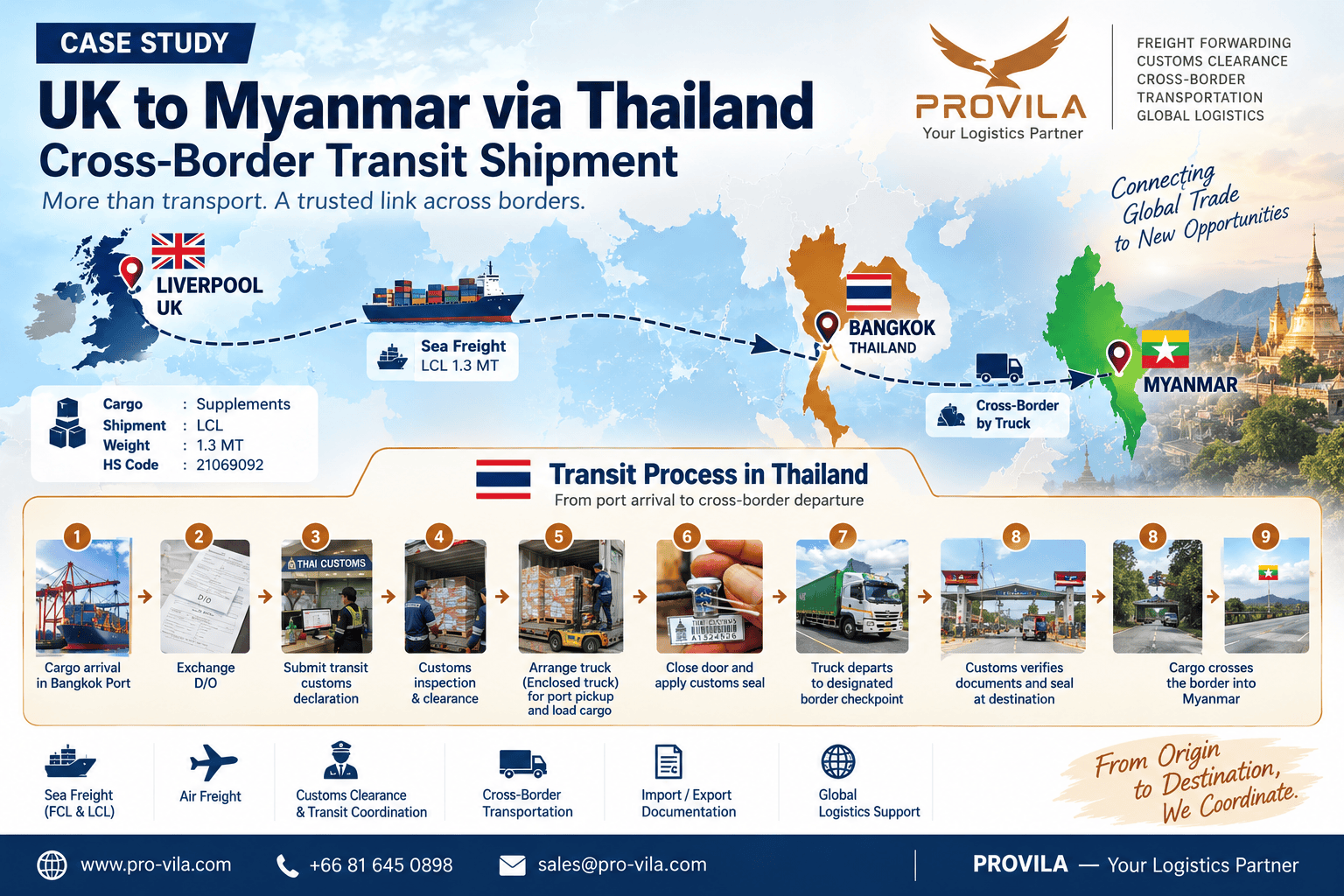
International logistics does not always mean shipping cargo directly from the country of origin to its final destination. In some cases, Thailand serves as an important transit point connecting international sea freight with cross-border road transportation to neighboring countries. In this real shipment case study, Provila Holding Co., Ltd. coordinated an LCL shipment of supplements originating from Liverpool, United Kingdom, arriving in Bangkok, Thailand by sea, before continuing to Myanmar by truck. What makes this shipment particularly interesting is that the cargo was not intended for import and sale in Thailand. Instead, Thailand was used as the transit country, requiring coordination between shipping documentation, cargo arrival, Delivery Order, Thai customs transit procedures, truck loading, customs sealing, border formalities, and onward transportation to Myanmar. Shipment Overview Origin: Liverpool, United Kingdom
Transit Country: Thailand
Final Destination: Myanmar
Cargo: Supplements
Shipment Type: LCL
Weight: Approximately 1.3 MT
Transportation: Sea Freight + Cross-Border Trucking
HS Code used for this shipment: 21069092 The overall transportation route was: Liverpool, UK → Bangkok, Thailand by Sea → Myanmar by Truck Although the route looks straightforward on a map, successful transit required planning before the cargo even departed from the United Kingdom.
Step 1: Preparing the B/L Correctly at Origin
One of the most important parts of this shipment was the Bill of Lading (B/L).
For a transit shipment, the shipping documents should accurately reflect the parties, cargo information and intended transportation route.
For this particular shipment, the B/L was arranged with:
Shipper: UK
Consignee: Myanmar
Notify Party: Provila (Thailand)
Provila was listed as the Notify Party because we were coordinating the transit customs procedures and cargo movement through Thailand for this shipment.
This is an important distinction: the cargo arrives physically in Thailand, but its final destination is Myanmar.
Therefore, the documentation needs to be prepared consistently with the actual logistics arrangement.
Step 2: Shipping Mark — Connecting the Documents to the Physical Cargo
Another important detail was the Shipping Mark.
A Shipping Mark helps identify which physical pallet or package belongs to a particular shipment.
For example, the pallets may carry a marking such as:
PROVILA
or another unique shipping mark provided and applied at origin.
The important point is that the information used for cargo identification should correspond with the actual markings appearing on the shipment.
When cargo arrives and needs to go through handling and customs procedures, clear identification helps the parties involved distinguish the cargo associated with the relevant shipment and documents.
For LCL cargo in particular, this becomes useful because the shipment is moving alongside cargo belonging to other shippers and consignees.
Step 3: An Important Transit Remark on the B/L
For this particular shipment, the B/L included a transit remark describing how the cargo would move from the UK through Thailand and onward to Myanmar.
The remark stated:
“CARGO IN TRANSIT FROM LIVERPOOL ENGLAND VIA BANGKOK THAILAND BY SEA AND THEN TO MYANMAR BY TRUCK. CARRIERS RESPONSIBILITY CEASES AT POD; FOR IN TRANSIT, ALL COST/ARRANGEMENTS/RISKS ARE ON CONSIGNEE'S OWNER ACCOUNT HS CODE 21069092”
The wording is important because it describes the intended routing of this shipment:
Liverpool → Bangkok by Sea → Myanmar by Truck
It also distinguishes the ocean carrier's responsibility from the subsequent transit arrangement after the cargo reaches the port of discharge.
The exact B/L wording required for another shipment can depend on the carrier, routing and shipment arrangement. Therefore, this example should be treated as the wording used for this specific shipment, rather than a universal B/L template.
Step 4: Sea Freight from Liverpool to Bangkok
After the origin documentation and shipping arrangements were completed, the cargo departed from the United Kingdom as an LCL sea freight shipment.
LCL — Less than Container Load — means the cargo does not occupy an entire container and is consolidated with other shipments.
For this shipment:
Cargo: Supplements
Weight: approximately 1.3 MT
Origin: Liverpool, UK
Port of Discharge / Transit: Bangkok, Thailand
Once the shipment reached Bangkok, the next phase of the operation began.
This is where the shipment changed from an international sea freight movement into a Thailand customs transit and cross-border trucking operation.
Step 5: Cargo Arrival and D/O in Bangkok
After the vessel arrived in Thailand, the cargo arrival status and shipping documents had to be checked before the shipment could proceed.
The next operational step involved obtaining/exchanging the Delivery Order (D/O) and completing the relevant local shipping-line or agent procedures.
The D/O is an important part of the cargo release process because it enables the subsequent handling and customs procedures to move forward.
At this stage, timing and document coordination matter.
The cargo cannot simply arrive in Bangkok and immediately be loaded onto a truck for Myanmar.
The Thai transit procedures must first be completed.
Step 6: Preparing the Transit Customs Declaration
Because the final destination was Myanmar rather than Thailand, the shipment required the relevant Thai customs transit procedure.
Provila prepared and coordinated the transit customs declaration based on the shipment documentation and intended route.
The documents and cargo details need to correspond with one another, including information such as:
B/L → Cargo Description → Quantity/Weight → Shipping Mark → HS Code → Transit Route
For this shipment, the HS Code used was: 21069092
HS classification should always be determined based on the actual product composition, characteristics, intended use and supporting documentation. The HS code shown here refers specifically to the classification used for this shipment.
Step 7: Thai Customs Procedures and Cargo Inspection
Once the transit declaration was prepared, the shipment proceeded through the applicable customs procedures.
Customs officers could verify the documents and inspect the cargo as required.
This is another reason why the Shipping Mark and documentation prepared at origin are important.
The information appearing on the shipment needs to allow the physical cargo to be connected with the relevant shipping and customs documentation.
After the applicable customs procedures were completed, the shipment could proceed to the truck-loading stage.
Step 8: Arranging an Enclosed Truck for the Transit Movement
Provila arranged an enclosed truck to enter the cargo handling area and collect the shipment.
The cargo was then loaded onto the truck.
At this point, the shipment was transitioning from: Sea Freight 🚢 to Cross-Border Road Transportation 🚚
But the cargo was still moving under the applicable Thai customs transit procedure.
Therefore, loading the cargo was not the end of the customs process.
Step 9: Closing the Truck and Applying the Customs Seal
After the cargo was loaded, the truck doors were closed and the relevant Customs Seal procedure was completed.
The seal plays an important role during a transit movement because the cargo is travelling through Thailand toward the designated border point under customs control.
The truck then departed Bangkok and travelled toward the designated border customs checkpoint.
This creates a controlled movement: Bangkok → Customs Transit → Border Checkpoint
rather than a normal domestic delivery within Thailand.
Step 10: Arrival at the Border Checkpoint
When the truck arrived at the designated border checkpoint, the transit movement had another customs stage to complete.
The relevant customs officers could verify:
- Transit documentation
- Vehicle/cargo information
- Customs Seal
- Cargo, where inspection was required
After the applicable transit procedures were completed, the cargo could proceed toward Myanmar.
The shipment therefore completed its Thailand transit journey:
UK 🇬🇧 → Sea Freight → Thailand 🇹🇭 → Customs Transit → Cross-Border Truck → Myanmar 🇲🇲
Why This Shipment Required Planning Before Leaving the UK
One of the most important lessons from this case study is that cross-border transit does not begin at the Thailand–Myanmar border.
It begins much earlier.
For this shipment, several elements had to connect correctly:
Origin Documentation
↓
Bill of Lading
↓
Shipping Mark
↓
Sea Freight to Thailand
↓
Cargo Arrival & D/O
↓
Transit Customs Declaration
↓
Thai Customs Procedures
↓
Truck Loading & Customs Seal
↓
Transit Movement to Border
↓
Border Customs Procedures
↓
Myanmar
A problem with documentation prepared at origin can therefore affect operations later in Thailand.
This is why reviewing the logistics structure before the supplier ships the cargo can be particularly important for transit shipments.
Thailand as a Transit Point for Cross-Border Logistics
Thailand's geographic position allows international cargo arriving by sea or air to connect with road transportation to neighboring markets.
Depending on the shipment, routing and applicable regulations, cargo may move through Thailand toward destinations such as Myanmar, Laos, Cambodia or Malaysia.
However, transit shipments require more than arranging international freight and booking a truck.
The shipping documents, customs procedure, cargo handling, transportation and border formalities need to form one coordinated logistics flow.
For businesses shipping cargo through Thailand, working with a local logistics partner that can coordinate both the Thailand side and the onward cross-border movement can simplify communication between the different parties involved.
How Provila Supports Cross-Border Transit Shipments
At Provila Holding Co., Ltd., we coordinate logistics solutions for businesses moving cargo into, out of and through Thailand.
Depending on the shipment requirements, our services include:
🚢 Sea Freight – FCL & LCL
✈️ Air Freight
🛃 Customs Clearance & Transit Coordination
🚚 Cross-Border Transportation
📄 Import, Export & Transit Documentation Coordination
🏭 Cargo Pickup & Delivery
🌏 International Freight Forwarding
Our approach is to understand the complete shipment route first — from origin through Thailand and onward to the final destination — so that the different stages can be coordinated as one logistics movement.
Planning a Shipment Through Thailand to Myanmar?
If your cargo is arriving from Europe, China or another international origin and needs to transit Thailand before continuing to Myanmar by road, Provila can assist with coordinating the Thailand-side logistics and cross-border transportation requirements.
For transit cargo, we recommend reviewing the proposed routing, B/L details, cargo information and shipping documents before the cargo departs from origin, because these details can affect the procedures required when the shipment reaches Thailand.
PROVILA — Your Logistics Partner
🌐 www.pro-vila.com
📧 sales@pro-vila.com
📞 +66 81 645 0898